Long-established South Australian sawmill N.F. McDonnell & Sons, based in Mount Gambier, was acquired by the AAM Investment Group in 2021 and now operates under the name AAM Timber. The company’s partnership with German mechanical engineering specialist Kallfass, based in Klosterreichenbach, dates back to 2015, when Kallfass installed an on-site sorting system with an integrated stacking system. In 2025, AAM Timber once again selected Kallfass as its equipment supplier, investing in a new cross-cutting and stacking line for main products.
AAM Timber specialises in processing green softwood timber, supplying the packaging and landscaping industries with bespoke cross-cut dimensions and custom formats for the manufacture of wooden packaging, pallets and fencing. Stewart Kanahs, Technical Project Manager at AAM Timber, estimates the target cutting capacity at approximately 460,000 m³ per annum. The new high-performance main products stacking line from Kallfass, equipped with a multiple cross-cut saw, is designed to ensure the planned increase in production output is achieved.
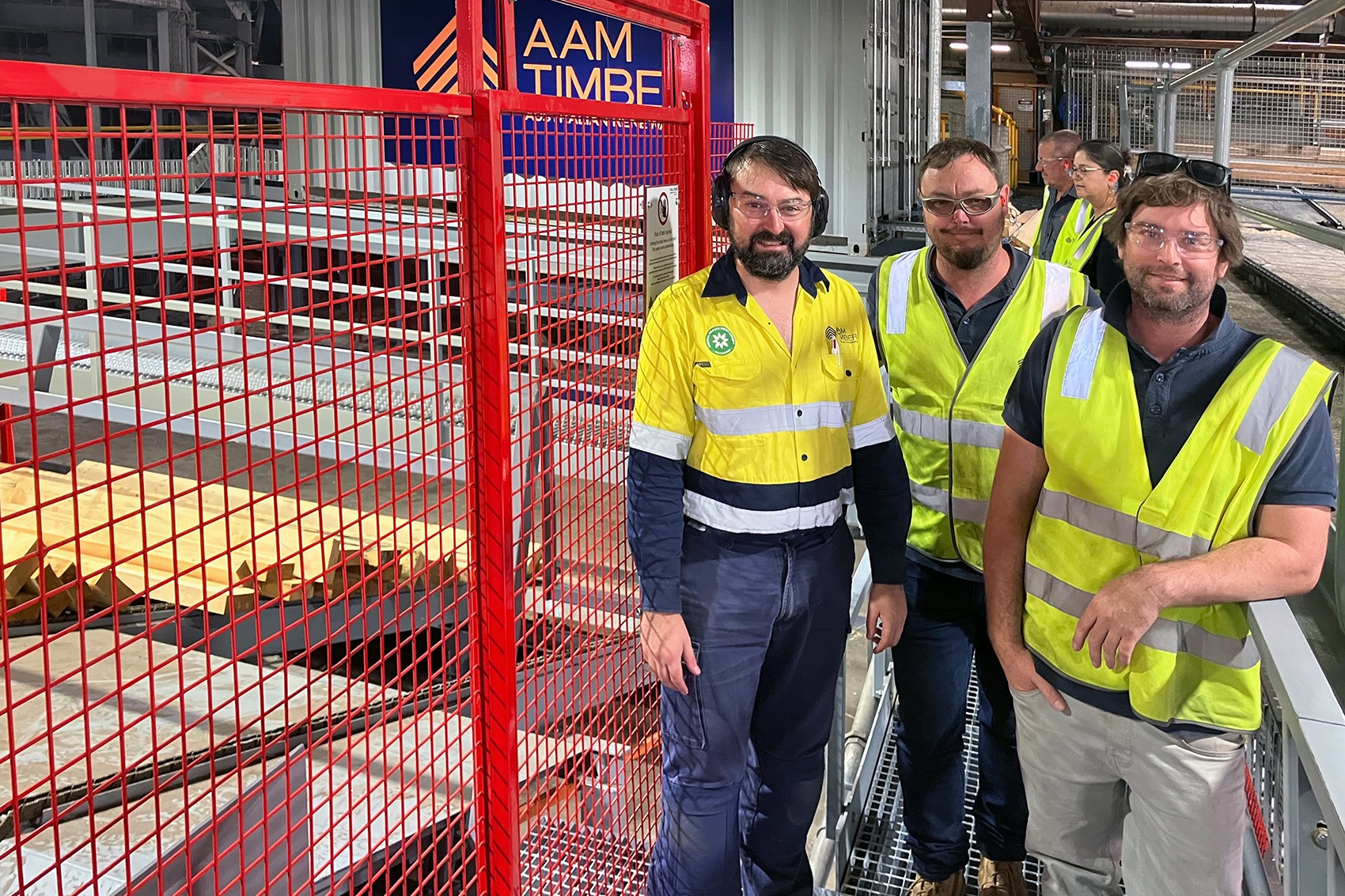
The main project team with Jason Rice, Stewart Kanahs and Josh Nobes from AAM Timber Mount Gambier (from left to right)
Flexible transfer
Thanks to a positionable chain conveyor, the Kallfass sorting system can receive main products either directly from the upstream HewSaw saw line or from the existing Kallfass sorting system. To allow this chain conveyor to operate independently of the saw line, buffer conveyors fitted with retaining pawls were integrated into the layout. The timber can subsequently be routed either to the new Kallfass main product stacker or to an existing stacking system. Via an inclined buffer conveyor, the products reach a step separator, are singled out, and are then right-aligned in the direction of feed. An operator can visually check and handle the products along the downstream assessment chain conveyor.
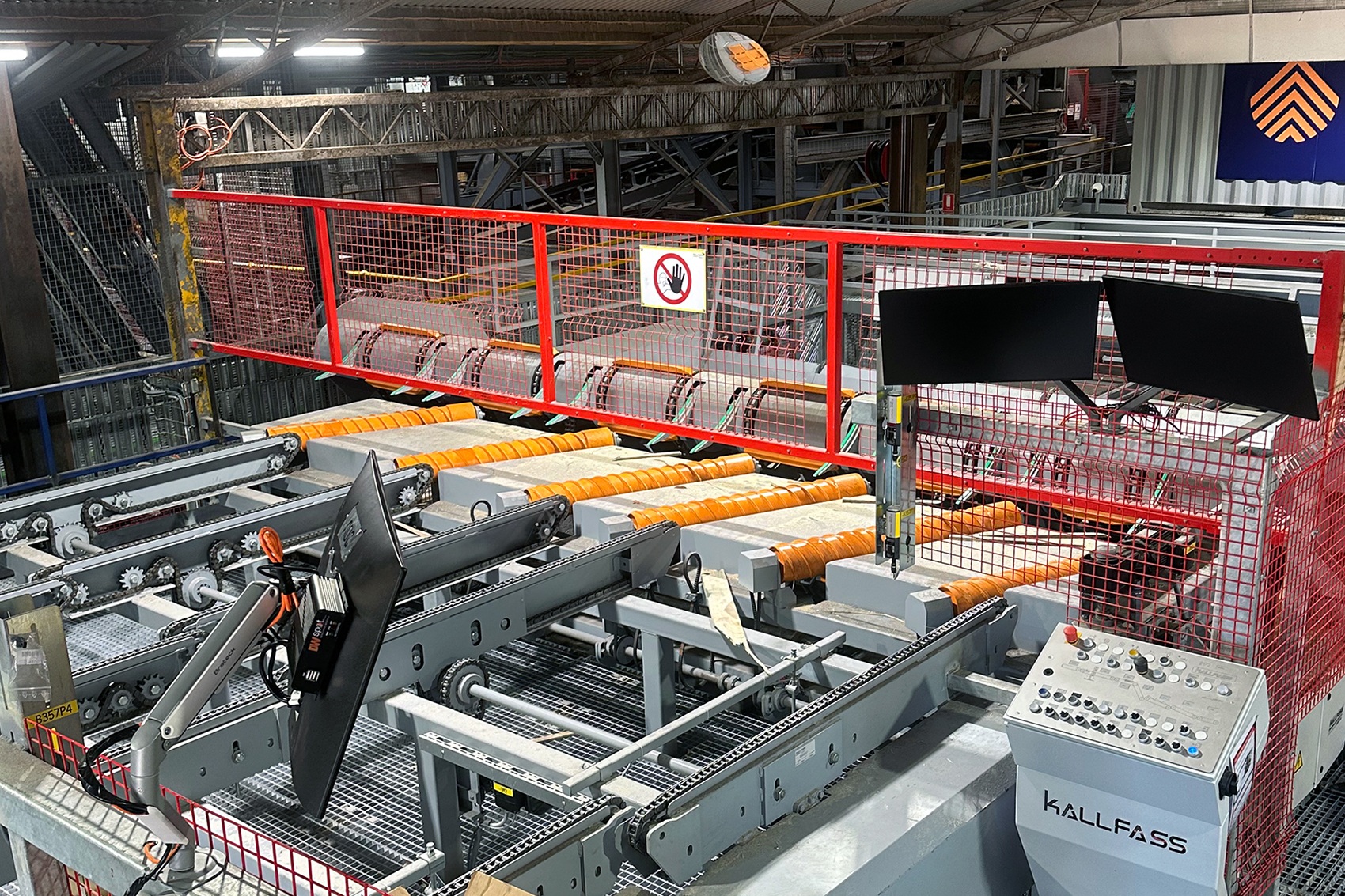
Since last year, at AAM Timber a new cross-cutting and stacking system has been in operation – a project that presented substantial spatial challenges during the installation of the new stacker.
Once layer creation is complete, the timber is fed into the Kallfass multiple cross-cut saw. This saw is equipped with five automatically positionable saw aggregates. The minimum cut length is 840 mm. The scrap wood drops down onto a belt conveyor and is transferred to a central trough belt conveyor located beneath the HewSaw line.
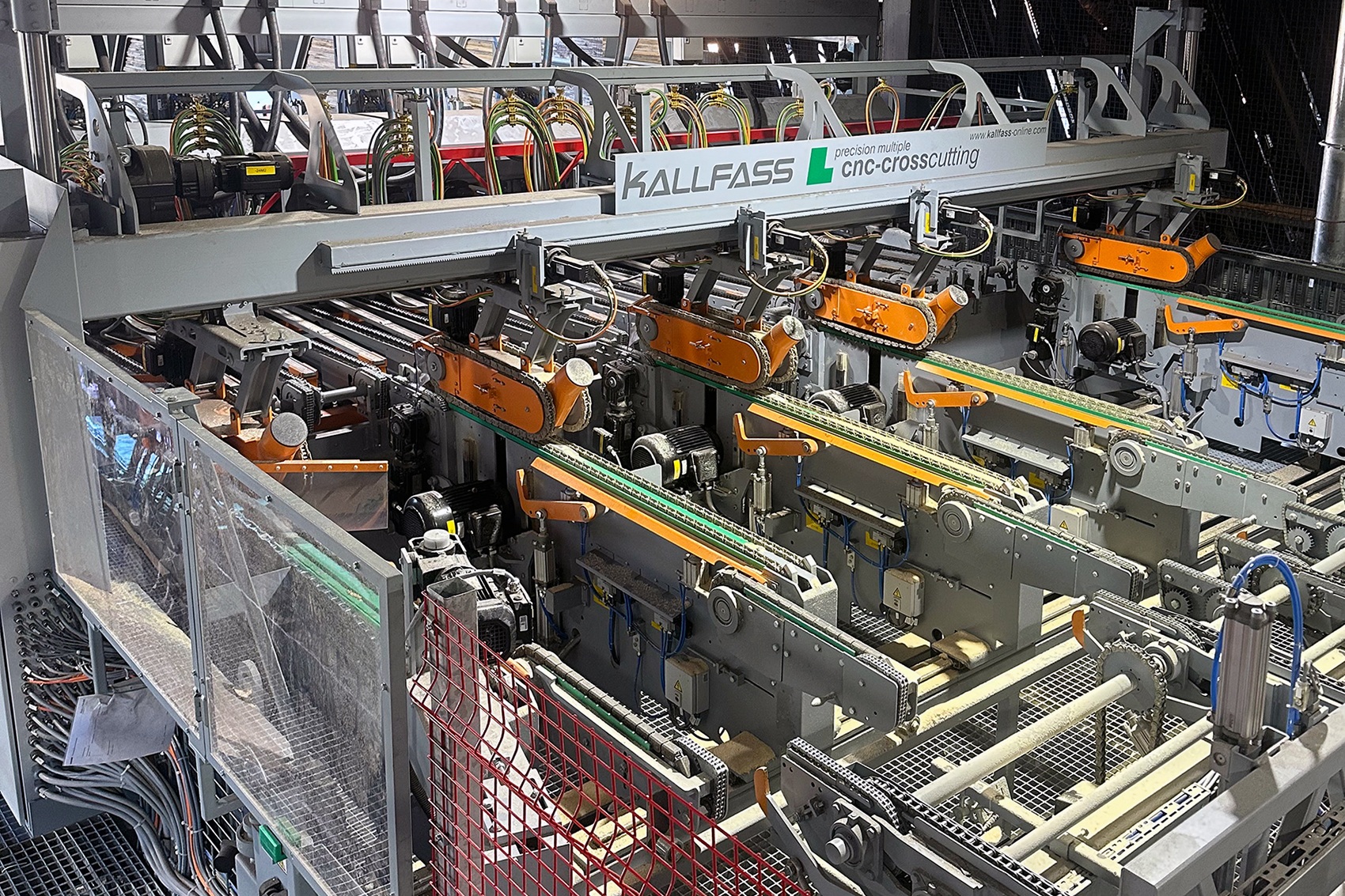
The Kallfass multiple cross-cut saw is equipped with 5 saw aggregates.
Variable-width stacking
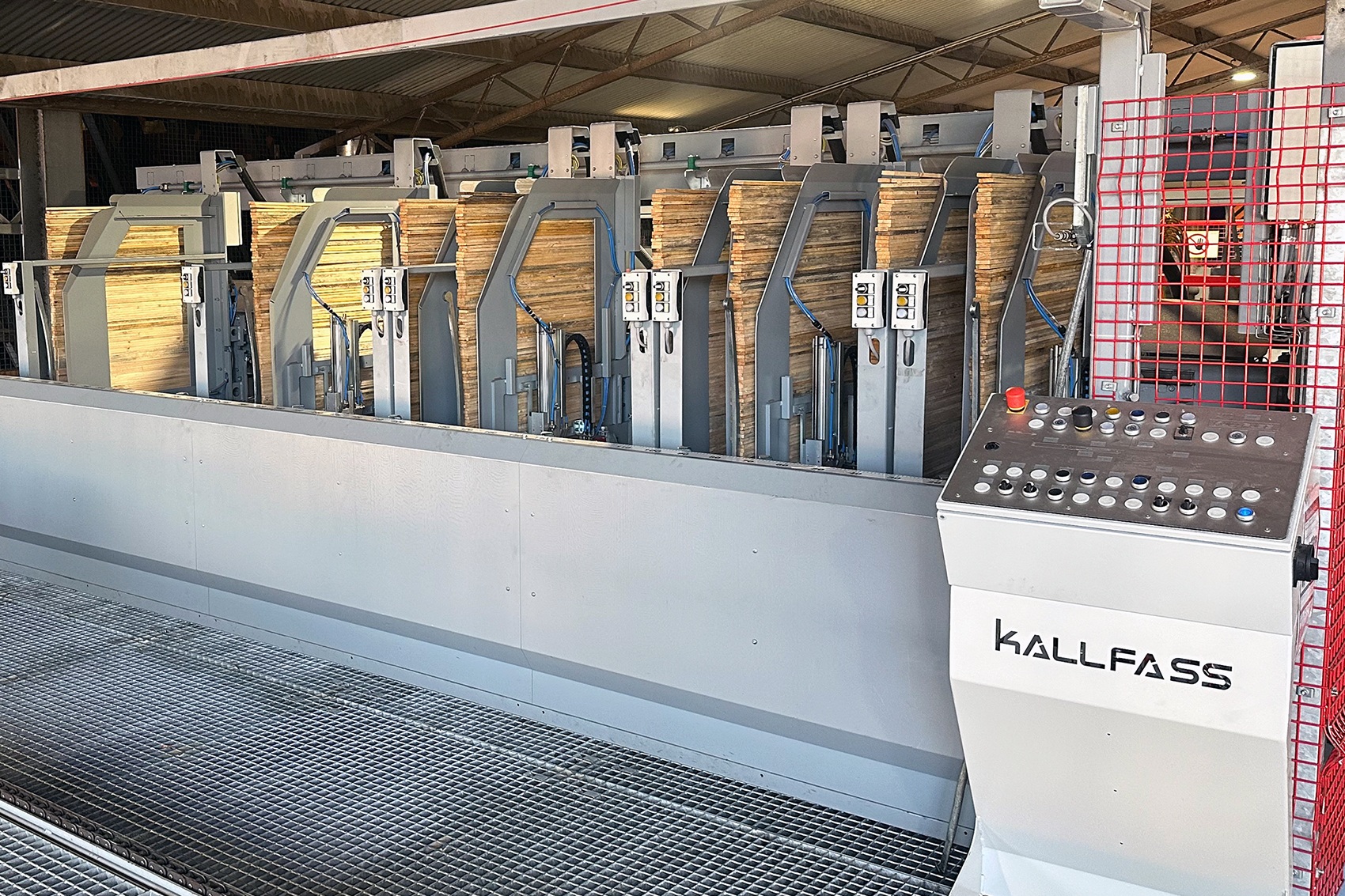
The downstream Kallfass stacker operates at a capacity of 14 layers per minute and produces stack widths between 800 and 1,200 mm. It features eight stick magazines that can be manually retooled for different stick dimensions. A chain conveyor delivers the stick bundles to the magazines, which are loaded manually by the operator.
The completed stacks are then transferred to a Fromm strapping system. Here, squared timbers are automatically strapped underneath the stacks – fed from two squared timber magazines – before moving onto a package chain conveyor for collection by forklift.
New conveying systems for side products
Alongside the main product stacking line, Kallfass also supplied the conveyor technology for the new side product discharge from the HewSaw line. The side product boards drop from the separator onto a carrier chain conveyor and proceed onto a conveyor belt, which transfers them to a roof-top chain conveyor. Next, a roller conveyor left-aligns the timber and conveys it onwards to an existing buffer conveyor. This ultimately feeds the boards into the existing Kallfass sorting system.
Hans Haist, Managing Director and Project Lead at Kallfass, emphasises that operational safety on the stacker line was just as critical to AAM Timber as high-performance throughput. Accordingly, the stick shafts on the stick magazines were specifically heightened, and four individual light barriers were installed to prevent potential operator error during magazine replenishment.
In addition, the available floor space posed a significant challenge. The new stacking system had to be engineered to fit precisely into the footprint of an existing stacker, as space constraints require finished stacks to be routed through the existing sorting system for removal. Furthermore, the package removal of an existing main product stacking system had to be tied into the new package removal system.
Commissioning within six months
Project communications were not without their hurdles, owing to the significant time difference between Germany and Australia. In this regard, Kallfass’s detailed familiarity with the existing setup at AAM Timber proved to be a distinct advantage. Even so, the final phase progressed rapidly: a mere six months elapsed from the start of mechanical installation to final commissioning.
According to project leads at AAM Timber, collaboration between Kallfass and AAM Timber was exceptionally effective. Kallfass, alongside Tui Technology and Fromm, provided continuous support throughout the project lifecycle – both remotely and on site. With the project having satisfied all key performance indicators, AAM Timber can now anticipate further productivity gains as well as a reduction in manual workload for its workforce.
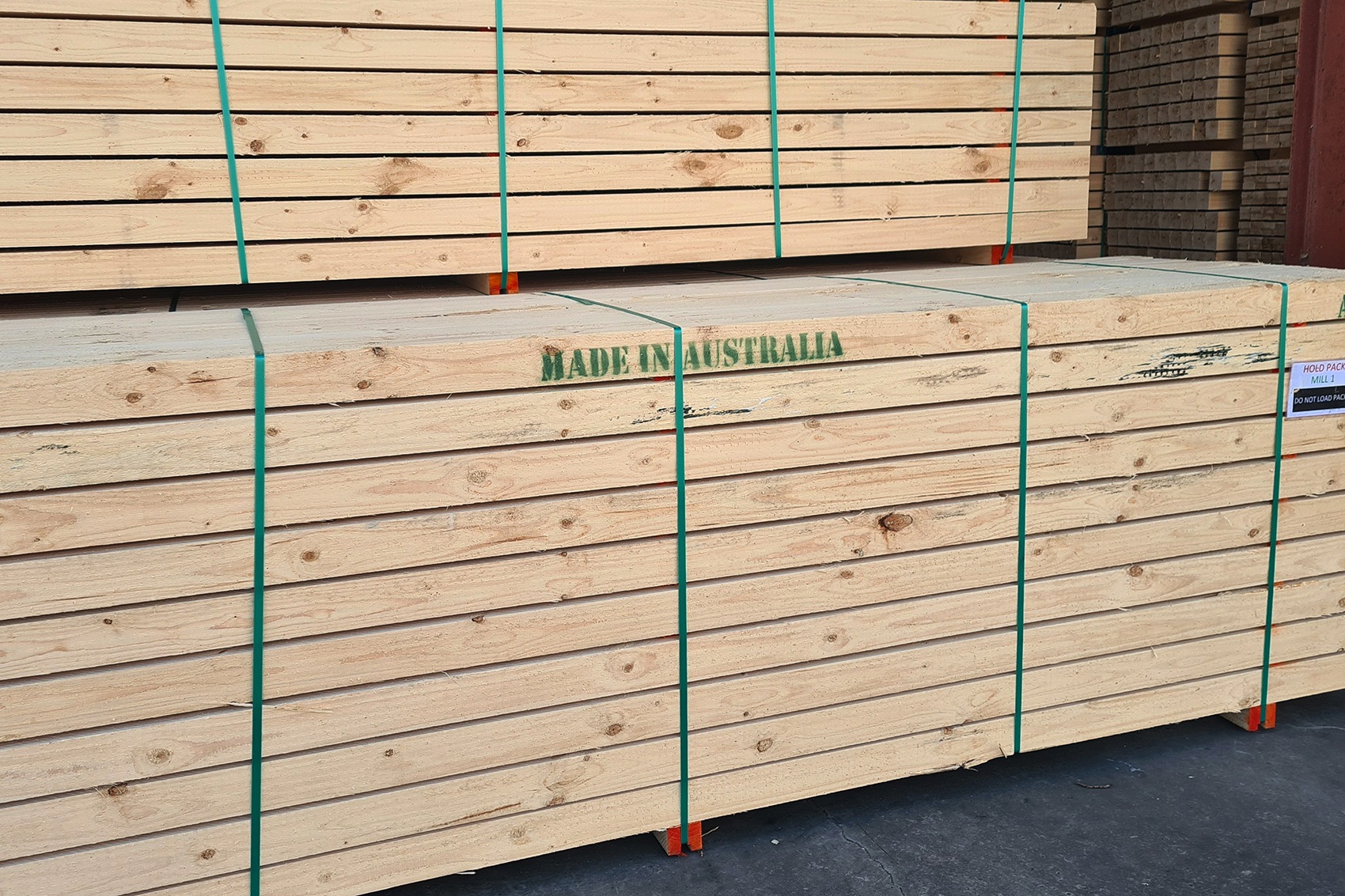
The result: Neatly stacked and strapped sawn timber stacks made in Australia
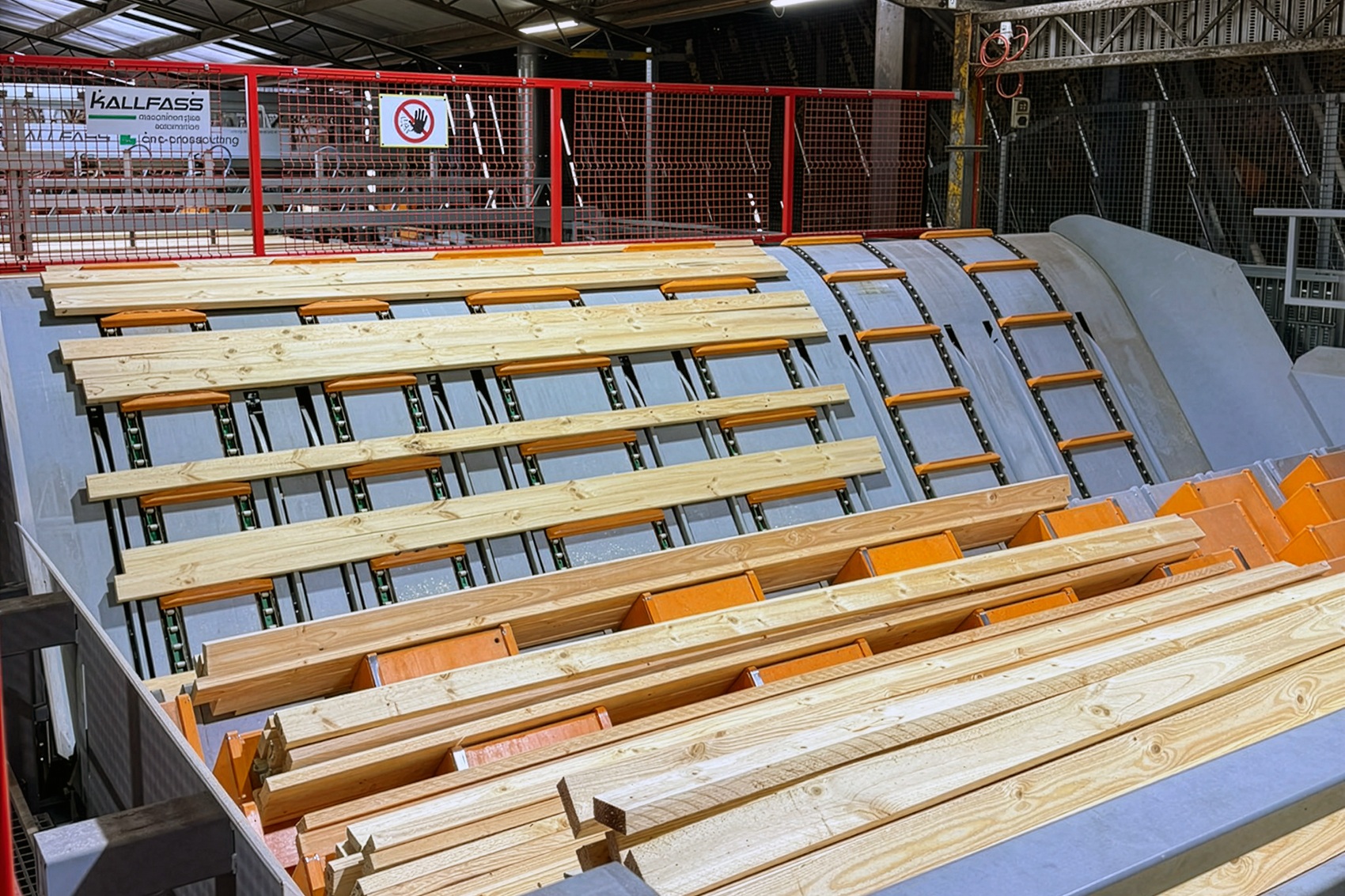
The step separator transfers the products to the unscrambler to then form layers.